Thursday, July 12, 2007

Police seek tenders for supply of 1,200kg of durians

12 Jul 2007, New Paper

WANTED: DURIANS (70 per cent bitter, 30 per cent sweet)
THE cops are asking someone to help them raise a stink.

By Ng Hui Hui

THE cops are asking someone to help them raise a stink.

And they are willing to pay for it.

But only if the taste is right - 70 per cent bitter and 30 per cent sweet.

Before you panic and start digging for your N95 masks, it's no terror attack - although some do consider the smell of durians a biological assault on the senses.

The Special Operations Command (SOC) of the Singapore Police Force has posted a message online calling for quotations to supply 1,200kg of the fruit - an order vendors are unlikely to turn up their noses at.

Durian sellers said that at the prevailing market rate, they would quote $8 to $15 per kg for the Mountain King durian, which is one of the most popular varieties now.

NOTICE ON GOVT PORTAL

The quotation notice was posted on GeBIZ last Friday and the closing date was 11.59pm on Monday.

GeBIZ is the Government's one-stop e-procurement portal where all the public sector's invitations for quotations and tenders are posted.

A police spokesman told The New Paper that if the estimated purchase value of the items is more than $3,000 but less than $70,000, 'open quotations on GeBIZ... shall be the default mode of inviting quotations'.

Operation Stink is a durian feast for more than a thousand police officers.

And to be part of Operation Stink, vendors must go through a 'critical evaluation' test. That is, they must provide durians for sampling.

Only the best will then be considered.

Vendors are also expected to brief the evaluation team on the types of durians available and the places of their origin.

And the chosen one must be fully equipped to take part in Operation Stink.

He must provide tables for opening the durians and takeaway boxes for packing them.

He must also provide two 'personnel' to open and serve the durians during every operation.

No slip-ups in the quality of the durians will be tolerated.

If the quality of the durians is not the same as those provided during the evaluation test, 'the vendor shall be liable and the Authority has the right to reject the goods and payment will not be made for the whole sum'.

Operation Stink will take place at two locations on 11 occasions. Four of those will be at the Police K9 unit in Choa Chu Kang and the rest at SOC in Queensway.

There may be simultaneous operations at the two locations and the vendors must be able to react accordingly.

Each session begins at 1700 hours.
If there are any changes, the 'Authority' will inform the vendor one day before the operation.

To ensure minimal collateral damage, the personnel must remove the durian husks from the premises after every operation and dispose of them appropriately.

Killing a pig and deceiving the public for art's sake. Have artists gone too far?

12 Jul 2007, ST

By Adeline Chia

HOW many ways can art offend? Let us count the ways.

Azhanti High Lightning, an installation artwork at the Nanyang Academy of Fine Arts (Nafa) which ended last week, drew public ire for its video which showed the artist slaughtering a pig.

The 21-minute video was part of a large installation spread over seven rooms by British artist Simon Birch, and included a large robot head sculpture and seven oil portraits.

In a short and artily edited clip in the video, he is shown striking a samurai sword at the pig's throat and beheading it in a few strokes.

Animal lovers saw red; but the artist didn't blush.

Then there was the controversy generated by a photography exhibition where art collective A Dose Of Light concocted an elaborate tale for a 'conceptual artwork'.

The group's website claimed that the 36 pictures which were to go on show at the Out Of Focus exhibition in City Hall were taken by a schizophrenic photographer named Wu Xiao Kang, who later killed himself.

It even started an online petition for the return of Wu's roll of film from an unnamed German institute, which gathered about 100 signatures.

When it was revealed in a Life! report that Wu didn't exist and the photos were actually taken by the three photographers in the collective, there was a public outcry.

The organiser of the ongoing exhibition, who had also been duped, pulled out the pictures from the show.

So, cruelty to animals, check. Public deception, check.

In the eyes of some folks, both works breached ethical boundaries in the name of art.

So, is there a line where cutting-edge art falls over the edge into something that's in bad taste or just plain unacceptable?

When Life! put this question to artists and critics, some maintain that challenging norms is the lifeblood of searching pieces of art.

But others say that there are some clear lines not to be crossed, such as taking an innocent life or taking the mickey out of the public.

Squeals of disgust

ARTISTS and critics Life! contacted are mixed on where the lines should be drawn for 'decency' in art, but they tend to go easier on lying than killing.

Audrey Wong, 39, the artistic co-director of The Substation, says there are certain universal ethical boundaries that art should have, and one is to avoid taking a life.

'How can you justify killing to make a point? It's so unnecessary,' she says.

'And if you're making an animal snuff film to talk about snuff films, then it's hard to know when to stop. What's next, human snuff films?'

Multimedia artist Heman Chong, 30, also draws the line at drawing innocent blood.

He also criticises that particular installation as bad art. He says: 'Want to show violence, so kill something - it's so uncreative. Even taking a piece of paper and shredding it with a razor would have been more interesting.'

Animal lovers agree.

Ms Deidre Moss, 55, executive officer of the Society for the Prevention of Cruelty to Animals, dismisses the artist's intention to show violence as an essential part of life.

'People have always been doing mean things to each other, we know this. It doesn't have to be demonstrated through the killing of an animal,' says Ms Moss, who also wrote in to Life!'s Mailbag page to register her unhappiness.

Yoga teacher Balakrishnan Matchap, 38, who saw the exhibition, was also outraged. He says: 'If you look at how the pig was killed - a jab in the throat, then three strokes to chop off its head - it's very cruel.'

But there are some who say there may be a case for killing animals in art if just to push the boundaries of what is acceptable.

Nafa director of art and corporate knowledge Bridget Tracy Tan, 34, said in a letter to Life!'s Mailbag page: 'We note that the scene of killing and violence is disturbing to some viewers but this is in keeping to a fact of life in human civilisation.' She declined to be interviewed for this story.

Contemporary artist Brian Gothong Tan, 26, says that challenging boundaries can be potent material for art.

'Killing has a different impact and meaning in art. Sometimes some form of violence and trauma is required for the artwork to work,' he says, though he says that he will not harm animals for his own art.

He adds: 'Toeing the line is important because the line can be arbitrary and based on what the consensus is. Killing for food is okay, commandos ripping birds' heads off for practice is okay. But for art, suddenly it's not.'

Contemporary artist Ho Tzu Nyen, 30, also feels it is hypocritical for people to get worked up about the pig.

He says: 'Azhanti is as controversial as the taking of animals' lives in the service of the human diet and the taking of human lives in war. Ethical boundaries should be applied across all domains of human activities and not be invoked only in the case of art.'

Not a big deal

AS FOR lying for art in the case of A Dose Of Light's elaborate hoax, most artists feel that it is no big deal.

Multidisciplinary artist Jason Lim, 41, who represented Singapore at the Venice Biennale last month, says the only crime the artists committed was getting busted.

'There's nothing wrong with creating a fictional character. Many writers write under pseudonyms too,' he says.

'They should have stuck to their story to the end, but I guess some artists can't keep secrets,' he adds with a laugh.

The hoax drew the fiercest criticism from Clubsnap, a local photography forum, which had more than 20 pages worth of comments mostly condemning the artists for lying to the public and exploiting the mentally ill.

Some forum members even wrote to Phish Communications, the organiser of the exhibition, to pull A Dose Of Light out of the show - which it eventually did.

Dental surgeon and shutterbug Kenny Poh, 39, thinks that Phish did the right thing.

But he adds: 'That said, everyone makes mistakes. The photographers in the group are still young, they probably didn't see the consequences.'

Still, it would seem that lying and pig-killing are pretty minor assaults on 'decency' compared to what some artists have done overseas.

A textbook case happened in the 1960s and 1970s when a group of artists known as the Viennese Actionists used animal carcasses, entrails and self-mutilation in their performance art pieces.

In 2000 in Denmark, goldfish were placed in blenders and visitors were told they could press the 'on' button if they wanted. At least one visitor did, killing two fish. Chilean-born Danish artist Marco Evaristti was apparently trying to test visitors' sense of right and wrong.

Animal groups campaigned against the exhibit, and the curator was fined for cruelty to animals.

Closer to home, examples are less dramatic. But one of the most controversial pieces was done by artist Josef Ng, who snipped off his pubic hair as an act of protest on media reporting of gay issues in 1994.

There was a public outcry, and it led to a 10-year no-funding rule for performance art by the National Arts Council.

But generally, Dr Eugene Tan, 34, director of the Lasalle College of the Arts' Institute of Contemporary Arts, prefers to keep an open mind about controversial art in general.

'Killing animals in the name of art and lying to the public are strategies that have been used by many artists. As with issues of ethics and belief, there is no right or wrong,' he says.

'One of the roles of artists in society is to make the public question assumptions about our society. If what an artist does achieves this in a meaningful way, then perhaps the use of certain strategies can be justified.'

However, as important as it is for art to probe and question, curator and art consultant Lindy Poh thinks that the public should revise its expectations of what artists can do nowadays.

Says Ms Poh, 38: 'We've come to expect that the really cutting-edge artists have insights that transform the way we live our lives.

'If we stop expecting artists to be gurus and geniuses, maybe we would be less outraged, less disappointed, and more responsible for how we ourselves can shift norms.'

---------------------------------

Why the 'hoo-ha' over ham?

DESPITE the uproar over his killing of a pig on camera, British artist Simon Birch claims he is an 'obssessive animal lover'.

Birch, 37, who is also a vegetarian, says: 'I'm absolutely against cruelty to animals. I treated the situation very humanely and in a controlled way.'

His installation work at the Nanyang Academy of Fine Arts, which ended last week, included a video that featured a clip of him beheading a pig.

The bloody scene lasted a few seconds, but the outcry lasted much longer.

Three letters were shot to The Straits Times' forum pages condemning it as an unnecessary act of violence.

Reader Tan Lay Khim, for example, wrote that the pig-killing was 'a misguided attempt' to depict the themes of life and death.

She added: 'A wanton disrespect and disregard for life is an extremely poor excuse for symbolism in any creative expression.'

But Birch, who is based in Hong Kong and well known there for his portrait paintings and as a deejay, thinks the hoo-ha is absurd.

He says: 'Get over it. If you had a broad mind and saw the world of art, and saw what else is going on, you will see that this is nothing.'

He adds: 'Pigs are things that people eat. They're not panda bears.'

He says that the scene was shot on a pig farm in Hong Kong under the supervision of an experienced farmer. Birch's meat-eating friends barbecued the pig afterwards and ate it.

He says: 'What's annoying is that this is the least interesting of the whole exhibition. The exhibition outside of this is complex, fascinating and amazing, and like nothing ever seen before in Singapore. And for the focus to be shifted into this silly little thing, it's a bit frustrating.'

He says that the installation, which cost almost $200,000, will be shown in Beijing in about six months' time.

His parting shot to enraged animal lovers?

'There are way more important things that we should be writing letters to the press about, the war in Iraq, for example. These are things that are really newsworthy. Killing a little piggy? No. Put the bacon sandwich down and then come talk to me.'


The King shows how

12 Jul 2007, ST Life!

By Loh Keng Fatt

MANY people have jobs that may not be that fulfilling. But they are afraid to try something new or explore a skill that is marketable.

Perhaps the person is just too lazy to change tack or is plain ignorant of how to do it.

In this excerpt from American horror writer Stephen King's how-to book called On Writing, he lays down a blueprint on getting started.

'So okay - there you are in your room with the shade down and the door shut and the plug pulled out of the base of the telephone.

You've blown up your TV and committed yourself to a thousand words a day, come hell or high water.

Now comes the big question: What are you going to write about? And the equally big answer: Anything you damn well want. Anything at all... as long as you tell the truth.

The dictum in writing classes used to be 'write what you know'. Which sounds good but what if you want to write about starships exploring other planets or a man who murders his wife and then tries to dispose of her body with a wood-chipper?

How does the writer square either of these, or a thousand other fanciful ideas, with the 'write-what-you-know' directive?

I think you begin by interpreting 'write what you know' as broadly and inclusively as possible. If you're a plumber, you know plumbing, but that is far from the extent of your knowledge; the heart also knows things, and so does the imagination.

Thank God. If not for heart and imagination, the world of fiction would be a pretty seedy place. It might not even exist at all.

In terms of genre, it's probably fair to assume that you will begin by writing what you love to read - certainly I have recounted my early love affair with the EC horror comics until the tale has grown stale.

But I did love them, ditto horror movies like I Married A Monster From Outer Space, and the result was stories like I Was A Teenage Graverobber.

Even today I'm not above writing slightly more sophisticated versions of that tale; I was built with a love of the night and the unquiet coffin, that's all. If you disapprove, I can only shrug my shoulders. It's what I have.

If you happen to be a science fiction fan, it's natural that you should want to write science fiction (and the more of what you've read, the less likely it is that you'll simply revisit the field's well-mined conventions such as space opera and dystopian satire).

If you're a mystery fan, you'll want to write mysteries, and if you enjoy romances, it's natural for you to want to write romances of your own.

There's nothing wrong with writing any of these things. What would be very wrong, I think, is to turn away from what you know and live in favour of things you believe will impress your friends, relatives and writing-circle colleagues.

What's equally wrong is the deliberate turning towards some genre or type of fiction in order to make money.

It's morally wonky, for one thing - the job of fiction is to find the truth inside the story's web of lives, not to commit intellectual dishonesty in the hunt for the buck.

Also, brothers and sisters, it doesn't work.

When I'm asked why I decided to write the sort of thing I do write, I always think the question is more revealing than any answer I could possibly give.

Wrapped within it, like the chewy stuff in the centre of a Tootsie Pop, is the assumption that the writer controls the material instead of the other way around.

The writer who is serious and committed is incapable of sizing up story material the way an investor might size up various stock offerings, picking out the ones which seem likely to provide a good return.

If it could indeed be done that way, every novel published would be a bestseller and the huge advances paid to a dozen or so 'big-name writers' would not exist.'

-------------------------------

# On Writing is available for loan from The National Library Board under the call number 808.02 KIN.

# Books For The Soul is a weekly column that highlights books which move, comfort or inspire.


Tuesday, July 10, 2007

Flickr Photos


Recently, i was sourcing for a photo sharing site and finally decided to settle for Flickr. Flickr is owned by Yahoo. Yahoo's existing Photos site would be shut down by September 2007. And any existing photo account, if not transferred to other photo sharing sites like Photo bucket etc, by then would be deleted.

I did have an Yahoo Photo account and found it to be extremely useful. However, as it was in the midst of being phased out, i got no choice but to use another photo site.

Frankly, it was not easy to look for a reliable photo sharing site. My requirements was that they should allow photos of a decent size (above 1 mega pixel each) , have enough mega memory storage space and can be accessed via albums.

I have fallen prey to 2 other photo sharing sites. One is esnips, which i sometimes could not access after a few months. Another is YouRep, a beta site and also one of Time magazine Top 10 websites of 2006. YouRep has totally disappeared! Who knows what happen? Maybe they ran out of funding or their organisation collapsed or whatever?

I do like Photo Bucket, but photo bucket is more for sharing photos. It is usefully if one intend to view the photos one by one. But then if one desire to view photos album by album, then Photo Bucket is not that suitable.

Another site I had used is Picasa Photos by Google. However, Picasa free account only has 1024 Mb memory space. Their pro account for US$25 annually comes with only 7Gb of memory space. So currently, yeah, i am using Picasa as a sort of backup photo site.

Anyway, i was happily uploading my pics to Flickr when i came across their first limitation, which i was unaware when i sighed up. That is, for a free account, i can only create up to 3 sets of batches. 1 batch set of photos is like a set of photo album. Without the ability to create more than 3 sets to organise the photos, all the photos would be lumped together into one main gallery.

And then i came across the 2nd limitation! That is Flickr would only show up to 200 recent photos uploaded. Any photos beyond 200 would be hidden from view until the account is upgraded to that of a pro account. (see message from Flickr below)

With a free account, I was to be able to upload up to 100Mb worth of photos each calendar month. But then this 100 Mb is bandwidth, not the amount of storage space on Flickr servers. So far, i have just exceeded 200 photos and 60% of my monthly quota!

Bumper! Well, frankly, i did not read any of these limitations when i signed up, especially the only 200 photos shown part. Maybe I had inadvertently skipped that section, or that i had missed the small fine print. If i had known, i would probably try to look for a better photo sharing site.

Hey, I am not a cheap skate. US$24.95 seems a good deal for unlimited storage, unlimited size and unlimited sets. That work out to be about US$2 per month. But the thing here is I am slightly pissed off about the 200 photos part.

Another option i could take is that i could always sign up for another Flickr free account. That means another 200 photos online storage. But I have thousands and thousands of photos! How many free accounts can i sign up?

Sigh!

I have recently organised my photos and wanted to put them online. So i suppose i should sign up for their pro account. But frankly, to me, this felt like something of a threat? I felt it's like Flickr held part of my photos hostage until i sign up for a pro account.

The threat part comes from the wording "come back unharmed". If this is someone sense of perverted humor, frankly, i dun find it that funny.

Come on! In this time and age, 200 photos for a free account is too damn low! I took more than 300 photos at one setting!

Well, nothing is for free. Some things are free up to a certain limit...and then they start charging! Bandwidth is not free, so is storage space and manpower!

But damn, some how, i felt that i have been screwed over!

---------------------------

Hey i wicked! About your photos...

You've run into one of the limits of a free account. Your free account will only display the most recent 200 photos you've uploaded. All of your photos beyond 200 will remain hidden from view until you either delete newer photos, or upgrade to a Pro account.

None of your photos have been deleted, and if you upgrade, they'll all come back unharmed.


Monday, July 9, 2007

Speak up - or get put down

09 Jul 2007, ST

Being overly modest is nothing to be proud of. Not especially if it means selling yourself short in the job stakes

By Jessica Lim

A FRIEND of mine - let's call him Joshua - recently had a rather trying time interviewing 20 people to fill several positions at a bank.

A slightly overweight male with sweaty palms seeking a temporary administrative job was asked: What are your qualities?

The graduate from a local university had one: He was extremely honest, he said. His faults? Overly sensitive, did not take criticism well and a bit of a slow-starter.

Maybe he should not have been quite so honest that day - he didn't get the job.

Others swung to the other extreme.

One applicant said he had no faults. This a few seconds after being unable to answer a technical question. He didn't make it either.

The foreign candidates, however, were a different story, said Joshua. They were not bogged down by a weird hybrid of false modesty and low self esteem. And the confident ones did not seem overly so. Overall, they sold themselves better.

So why do perfectly capable and qualified individuals here lag behind when it comes to marketing themselves? I put it down to the self-defeating culture of humility and discretion.

It has been like that for generations.

Each time my relatives are complimented on their children's achievements, they dismiss them as 'nothing' despite being obviously extremely proud.

In contrast, Westerners are raised in more open households. They are - more often than not - brought up to say what they mean.

The result: Locals are sometimes reduced to an inarticulate mess when faced with such plain-speaking rivals.

The advent of globalisation has led to the free movement of people - especially those in knowledge-based industries. It also means all compete on the same playing field.

That terrifies some Singaporeans.

A recent Sunday Times poll of 448 people found that nine in 10 fear their jobs may be taken away if more foreigners come to Singapore.

In 1970, non-Singaporeans made up about 10 per cent of the population. This January, the figure was 25 per cent - about a million people.

The number will probably rise even further with more foreigners being welcomed here.

Take, for example, the Work Holiday Programme, which will start this December. It allows undergraduates and graduates between the ages of 17 and 30 from universities in eight places - Australia, France, Germany, Hong Kong, Japan, New Zealand, Britain and the United States - holidaying here to look for a job and stay on for six months.

The hope is that they will find Singapore an attractive place to work and live in.

And it is. For Singaporeans, too. They just need to open up a bit.

A recent Straits Times article cited a 25-year-old business student who lamented that there was no way locals could compete with foreigners.

He is wrong. We can. We just need to allow ourselves to.


ASK THE FOODIE

08 Jul 2007, ST

By Chris Tan

Hot fun

Q Fried hor fun is nothing without the slightly burnt ('wok hei') taste but this is almost impossible to recreate using a domestic gas stove. What is the best method to do it at home and get a nicely burnt flavour without burning the meal?

Benedict Andrew Lim Wee Yong


A There's no way of getting wok hei - literally 'wok breath', which doesn't quite equate with 'burnt' but refers to that particular intensity of aroma produced by high-heat cooking - with a non-stick cooking vessel.

However, if you have a good, well-seasoned steel or iron wok, turn your heat (and cooker hood) up to the max, make sure the wok is extremely hot before adding the oil and hor fun, and keep your frying arm moving, you should get at least a modicum of wok hei.

Lacking the above, you might like to try this. I learnt to make Laotian hor fun at a cooking class in Laos.

First, you fry the rice noodle clumps in a little hot oil, until they are lightly browned on the outside. Then you break an egg over them and stir lightly until it's cooked, by which time the noodles have browned a little further and developed a delicious, very lightly caramelised taste.

The other ingredients are stir-fried separately and given a quick toss with the noodles before serving. It's not quite the same as wok hei, but it's jolly good.

---------------------------------

Garlic gaffe

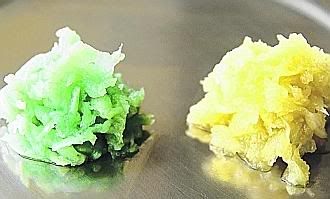
Q I grind fresh garlic when I make popiah but after some time, it turns lime green and loses its flavour. How do popiah sellers prevent theirs from turning green?

Lim Lee Eng


A The aroma and flavour of garlic come from a family of sulphur compounds. Crushing or pounding garlic breaks its cells and allows these compounds to mix and react with other cellular substances, forming new molecules that, while perfectly edible, happen to be a slightly alien shade of green.

To prevent this from happening, you can do three things. First, use new-season rather than aged garlic as the former is less rich in sulphur compounds; second, pound the garlic just before serving time.

Lastly, stir some oil into the garlic paste immediately after pounding. The oil coats the garlic fragments, reducing the amount of sulphurous juice that leaks out.

In the photo, both clumps of pounded garlic have been standing at room temperature for 10 hours.

Photo Sharing and Video Hosting at Photobucket

The garlic on the right was mixed with oil and has darkened a little from its original ivory hue. But as you can see, it's far more acceptable than the Yoda-esque oil-free mound on the left.

Adding salt to the garlic does nothing, while adding vinegar accelerates the colour change.

------------------------------

Powder play

Q Several readers have asked for information about the differences between cream of tartar, baking powder and bicarbonate of soda, so here's the lowdown.


A Baking soda, also known as bicarbonate of soda, is an alkaline compound, usually sodium bicarbonate. It neutralises acids in dough or batter. Water and carbon dioxide are by-products of this reaction: Bubbles of the latter expand in the oven's heat, enabling the dough or batter to rise.

It's often used alone or together with baking powder in cakes with acidic ingredients - sour cream, buttermilk, molasses, fruit, honey - and is also added to cookies to encourage browning.

Ammonium bicarbonate is another alkaline compound used for leavening, and to achieve a light, crunchy texture in pastries. This is because it reacts with acids to form ammonia and carbon dioxide - gases which evaporate quickly - but no water.

However, it's pongy in raw form, and the recipe has to be baked long enough to dispel the ammonia fumes.

Cream of tartar is an acidic salt, potassium bitartrate. Its most common role is to stabilise beaten egg white and improve the texture of egg-foam cakes such as chiffon cake.

Baking powder is a mixture of chemicals that react to yield carbon dioxide when liquid is added. It usually consists of an acid salt, an alkali, and a filler, usually cornstarch, to absorb moisture and prevent the compounds from reacting in the jar.

None of the above are interchangeable. Each has different powers and specific roles in baking, so follow reliable recipes closely for the best results.


New Old Airport takes off

08 Jul 2007, ST

The revamped Old Airport Road food centre is winning back regulars after its $5.8m facelift

By Huang Lijie

FOOCHOW fishball noodle seller Siah Wee Leng had to close his shop just four hours after re-opening it at the newly upgraded Block 51 Old Airport Road food centre.

He had sold out everything.

Business is back and even better at the 34-year-old food centre, which closed in March last year for a $5.8 million facelift under the National Environment Agency's Hawker Centres Upgrading Programme (HUP).

It re-opened last Sunday.

Of the 180 food stalls operating at the centre before the upgrading, 163 have returned, including popular stalls such as Toa Payoh Rojak and Mattar Road Seafood Barbecue (see other story).

When the centre closed for renovations, 74 food stalls relocated to a temporary spot behind the centre, including most of the famous ones.

However, many old-time customers stopped patronising the relocated centre.

'The old food centre was bad but the temporary site was even hotter and more stuffy,' said Mr Robin Koh, 35, a manager in the optical industry who used to eat there two to three times a week prior to its revamp. He stopped dining there during the centre's closure.

According to 10 hawkers LifeStyle spoke to who moved to the temporary centre, business dropped by 20 to 30 per cent.

The revamped hawker centre, which has 168 food stalls - five are yet to be occupied - has, however, won back its regulars with its clean look and better ventilation.

Filthy floor and wall tiles and grimy tables and stools have all been replaced.

A new mechanical exhaust system, which reduces cooking fumes, was installed.

There is even an alfresco dining area with 30 umbrella-shaded tables located in the food centre's open plaza.

Curious visitors checking out the improved two-storey food centre have added to the re-opening buzz.

Technician Jeffrey Tan, 42, who had never been there, came on his day-off from work last Tuesday.

'If I'm ever around the area again, I'll be sure to drop by to enjoy good food in a clean environment,' said Mr Tan, who lives in Bedok.

The hawker centre is one of 80 selected for HUP, a 10-year plan launched in 2001 at an estimated cost of $420 million.

To date, 58 have been upgraded, including Adam Food Centre, Chomp Chomp Food Centre and Newton Food Centre.

Renovations are going on at six other locations, including Block 37A Teban Gardens Road, slated to re-open by the end of this year, and Block 335 Smith Street, to be completed early next year.

The list of 16 other food centres scheduled for upgrading has not been finalised, said an NEA spokesman.

Most customers embrace the improvements at Old Airport Road, but Mr David Ngu, 60, who has frequented the food centre for the last seven years, cautioned: 'This place is new, so naturally, it appeals to the senses. The challenge lies in maintaining the place as it is in the long run.'

While the stalls on the first floor are drawing crowds, business is a lot quieter for the 54 shops on the second floor which sell everything from clothes to children's toys.

Madam Lily Tan, 52, who owns a store providing alteration services, said in Mandarin: 'There has been no spill-over from the food business downstairs.

'I hope things will change in the next few weeks.'

---------------------------------

Food, glorious food

WELL-KNOWN food stalls are getting a new lease of life at the revamped Old Airport Road Food Centre


Hua Kee Hougang Famous Wan Ton Mee,
01-02

Open: 11am to 11pm, closed on Mondays

Famous for: Wonton noodles, $3/$4

Waiting time (peak periods): 30 minutes


Meng Kee Minced Meat Noodle and Foochow Fishball,
01-103

Open: 6pm to midnight, closed on Sundays

Famous for: Foochow fishball noodles, $3/$4

Waiting time: 20 minutes


To-Ricos Guo Shi (kway chap),
01-135 and 01-136

Open: 11.30am to 4.30pm, closed on Mondays

Famous for: Pig trotters, $4

Waiting time: 30 minutes


Lao Fu Zi Fried Kway Teow,
01-12

Open: 11am to 11pm daily

Famous for: Fried Kway Teow, $3/$4/$5

Waiting time: 15 minutes


Nam Sing Hokkien Fried Mee,
01-32

Open: 11am to 7pm, closed every first and 15th day of the lunar calendar

Famous for: Hokkien noodles, $3/$4/$5

Waiting time: 40 minutes, but customers can call 6440-5340 to pre-order starting Tuesday


Xin Mei Xiang Prawn Mee,
Lor Mee, 01-116

Open: 7am to 3pm daily

Famous for: Lor Mee, $3/$4

Waiting time: 30 minutes


Mattar Road Seafood Barbecue,
01-63

Open: 4 to 11pm, closed on Tuesdays and Wednesdays

Famous for: Charcoal-grilled chilli crab, $28/kg

Waiting time: 30 minutes


Toa Payoh Rojak,
01-108

Open: Noon to 8pm, closed >on Sundays

Famous for: Rojak, $2/$3/$4/$5

Waiting time: 30 minutes.


Cho Kee Noodles,
01-04

Open: 11.30am to 11.30pm, closed on alternate Wednesdays

Famous for: Wonton noodles, $3/$4

Waiting time: 20 minutes


What's wrong with being easily contented?

08 Jul 2007, ST

By Mathew Pereira

A FRIEND retired recently after serving all these years as a naval officer. He, like all who had served as regulars in the Singapore Armed Forces, collected a lump sum of cash upon leaving.

He was a colonel and had been in the SAF from the time I met him on the rugby pitch during my NS days and again in university.

During our gatherings and football games the past couple of months, at least one of us in the group would ask if he had found a job yet.

'Nope,' he'd say, and add that he had no plans to rush into one.

There would be follow-up comments and questions - Don't you feel bored? How can you not work? Surely the money will not last you another 30 years?

This is one guy who never used to show up for any of our get-togethers in the last 20 years, not even Christmas parties. He would be out at sea, on recall or training in some foreign country.

In fact, at a wedding where he was supposed to be the master of ceremonies once, his unit activated a recall and the groom was left scrambling for a replacement from among the dinner guests.

Those days are gone.

A bachelor, the former rugby player has not only been showing up at every gathering but also for our football sessions.

He is happy to be able to do all these, he said.

But it was his answer to the question about the fear of not having enough to last till old age that impressed me.

'Just live simply. I am happy with what I have,' he said.

He had decided that he would be content with what he had. He did not dismiss the idea of working but he was not about to rush into any job just for the money. If he was going to work, it was going to be something that he enjoyed and, until then, he would live simply.

When three out of every 200 people in Singapore are millionaires as reported recently, retiring at 50 and not wanting to pursue more wealth is not an easy decision to make.

I have heard at least a handful of people say that the next time there is a count, they want to feature in the millionaire end of the statistics.

And I see many examples of it around already.

I had a recent chat with a friend whose condominium went en bloc. He was one of those who tried to squeeze as much money as he could from the deal. He was already getting a hefty amount but that wasn't enough.

He said: 'Wouldn't you do it? Wouldn't you push for more money?'

I said: 'Of course, more is good but at what point do you stop?' His hard bargaining almost scuppered the whole deal.

But he was not an aberration.

I chatted with another close friend, one I've known for over 20 years and whom I believed had many things in common with. Even he said: 'Matt, I must be honest. I can't say I would not have done the same thing.'

I am not at all anti-wealth but I have often been reminded that one of the secrets to happiness in life is contentment.

These reminders come from friends whom I feel have the right perspective. A friend dropped in at my home three days ago, on his way to work, just for a chat. Our talk moved on to work, house, friends.

He told me that he was enjoying working in his company, that he had made a name for himself in the industry he was in and could walk out any day and get a 50 per cent jump in his salary. But he decided that he would stay where he is because he enjoys the work and the environment.

He has a decent home which he bought many years ago and could upgrade to a bigger one with what he earns but has decided against it. He is going to stay put. That is contentment.

I have seen some who epitomise discontentment. They are constantly unhappy. One can be discontented with anything - from your job to your house and your car to your spouse.

Sticking around with people who are contented helps.

One such is this middle-class couple who have two boys. They made a conscious decision not to upgrade but stay in their five-room HDB executive maisonette flat in Woodlands. Their two boys attend neighbourhood schools and many of their friends come from lower-income groups.

The mother told me about how, when the boy's classmates visit their home, they would exclaim: 'Wah, you so rich' or 'Wah, your house is so big' and 'Wah, your father has a car!'

Her 11-year-old became very conscious and there were times he decided not to take his new adidas bag or other branded goods to school for fear of reinforcing this idea that he came from a rich family.

But the boy was rattled for a while when he started taking tuition lessons at an expensive tuition centre recently. All the kids there came from wealthy families and after a few sessions he remarked: 'I don't have the latest phone', 'I don't have the latest PlayStation', and 'Why do we have such a small car?'

Overnight, his perspective changed.

It took some talking from the parents to undo the damage and make him see things correctly.

Quite often we hear people dismissing a person in a condescending manner with: 'Oh, he is easily contented.'

That 'easily contented guy' may be on to something, which many of us have yet to find out about.


How do I get along better with others in my workplace?

08 Jul 2007, ST

Q I AM a single, 30-year-old software engineer who has been working in Singapore for four years.

Physical disabilities recently forced my mother to retire early.

To me, financial stability is critical because I have to take care of my mother.

Six years ago, I graduated with a degree in engineering - majoring in communications systems. I constantly upgrade my software technical skills with my own resources.

There have been rumours that software engineering positions are being outsourced to countries such as India and China, where resources are cheaper and the professionals, just as competent.

The technical path is also not one that graduates like me would want to consider.

There are also rumours that graduates may not able to secure mid-term contractual jobs after finishing at the university.

I am emotionally very disturbed by the appraisal and comments from some managers in the industrial sector.

One manager said he couldn't communicate effectively with me; another, in a different area, felt he could communicate with me but said that my skills in the research and development area were not comparable to those with PhD and Masters degrees.

I also don't engage in small talk and am a target for gossip.

I suspect I am lacking the emotional intelligence, technical skills and credentials that employees are looking for, although I want a mid-term career in the industrial sector and am willing to put in long hours.

The other obstacle is that I cannot afford the time and effort to attend job interviews.


A THERE seem to be a number of challenges you are facing. If you have not already done so, do 'compartmentalise' the various issues.

Putting everything on one plate could be one reason why you are feeling emotionally stressed out. Looking and tackling them individually or in bite-sizes could allow you to focus and come up with more effective solutions.

On the issues of emotional quotient and communication skills, realising that you could potentially have gaps to close is the first step towards improving the situation.

The next step is to take a much higher level of interest in people.

When you interact with others, consciously initiate questions and get them to talk about themselves.

Listen attentively and keep the conversation going, focusing your attention on the other person rather than yourself.

Another tip is to be more conscious of the impact of your behaviour on others.

For example, before you say something, pause for a second and ask yourself how the recipient is likely to react. If necessary, change some of the words you will use and watch the tone of your voice and body language.

You could consider identifying a mentor and having him or her coach you on how to close the gaps. You may also consider hiring a coach to work with you on this.

To be an effective employee, you have to not only continuously upgrade your technical and soft skills, but also get along well with people, warts and all.

Having said these, you mentioned that one manager said he could not communicate effectively with you - if this is indeed the case, the issue seems not to rest with you but with your manager?

As to the demand for the type of talent and the outsourcing activities you mentioned, there is little that you can do to influence how employers meet their business needs.

What you can definitely do is to continue managing your career as well as upgrading your knowledge and skills to ensure that you maintain your employability.

These days, having a job is not as important as being employable, whether in a full-time or part-time capacity, so you must have the relevant and up-to-date knowledge and skills.

If you feel that looking for an alternative job is a priority, I am sure you will somehow be able to find the time for job interviews.

Paul Heng
Founder
NeXT Career Consulting Group, Asia


Thursday, July 5, 2007

Solid perfumes

05 Jul 2007, ST, Urban

Solid perfumes come in pretty little packages, smell good and can make you a tidy profit

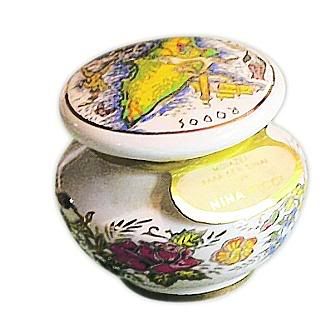
Corinna Chang has a unique obsession with decorative trinkets that smell - and appreciate in value. The director of Klassique Music, a music school in Balmoral Plaza, collects solid perfumes - scents that come in waxy, balm-like consistency - for the high prices that the eye-catching metal cases they come in can fetch.

Such perfumes are made by only a handful of cosmetics houses such as Max Factor, Shiseido and Estee Lauder. Going by its client list, Estee Lauder estimates there are about 200 solid perfume collectors in Singapore. Its most avid collector, Ngiam Su Ying, deputy director of a statutory board, owns 300 solid perfumes.

But Chang, who is in her 40s, has a cache of 500 solid perfumes made between the 1950s and today, singling her out as someone most dedicated to the acquisition of these collectibles.

These solid perfumes are prized because their containers are often made of high-gloss enamel, studded with rhinestones or intricately carved from ivory. Chang hopes to reap a substantial profit from her collection one day as solid perfumes, when kept in good condition, appreciate in value over the years.

Photo Sharing and Video Hosting at Photobucket

Similarly, perfumes in collectible bottles, like those from French glassware brand Lalique also appreciate, making them good investments for magpie-types with penchants for decorative bling.

Chang has already earned an 'attractive little sum' selling about 20 of her solid perfumes through online auctions and via her personal website, www.rubylane.com/shops/my-delightful-vanity. She usually sells them for about 40 per cent more than what she paid for them.

'Solid perfumes are very valuable and luxurious because they are pretty, handmade, produced in very limited quantities and never repeated,' says Estee Lauder Singapore's brand general manager Jo Yong.

Online marketplaces, like Yahoo! Auctions and eBay, sell solid perfumes for at least 30 per cent of their original sale price. The price tag can go much higher, up to 200 per cent of the original, if the piece is particularly rare or in high demand - or, better yet, both.

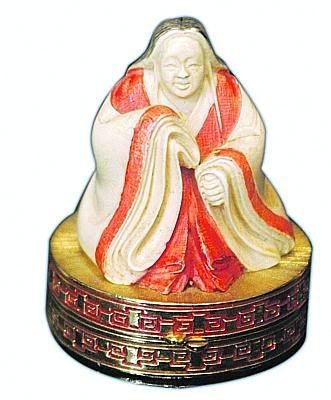
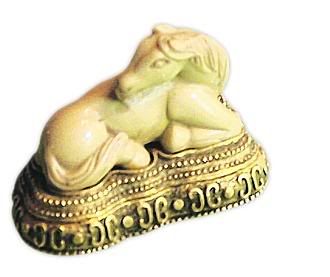
Some of the most avid collectors, like Chang, willingly fork out US$1,700 (S$2,606) for a particularly exquisite or vintage solid perfume case. That is how much she paid on eBay for the Estee Lauder Oriental Princess (left), the rarest piece of the Oriental collection, which comprises nine trinkets of carved ivory.

Photo Sharing and Video Hosting at Photobucket

The Oriental Princess is a good example of how profitable a business collecting solid perfumes can be. When it was first sold in 1981, it cost US$35. Now, according to Chang who has monitored some recent online auctions, it is now worth up to US$4,000 - a whopping 114 times the original price. Imagine selling 10 of those for a profit of US$3,965 each. What a windfall.

Says Ngiam, 45: 'The asking price for solid perfumes in online auctions is sometimes more than double the original cost. It's crazy.'

Another Singaporean collector who has been collecting solid perfumes for possible monetary gain is 47-year-old homemaker Veronica Goh, who has a collection of 50 solid perfumes worth about $10,000.

'I started collecting them more than 10 years ago simply because I liked the design of the cases. Over the years, I found out from other collectors that these things go up in value, so I now collect them for investment,' she says.

Photo Sharing and Video Hosting at Photobucket

Collectors say particularly good solid perfumes to invest in are limited edition ones. These include those sold exclusively at posh department stores in New York and London, like Saks Fifth Avenue, Neiman Marcus and Harrods, and special collaborations with American evening bag designer Judith Leiber and American homeware designer Jay Strongwater.

Photo Sharing and Video Hosting at Photobucket

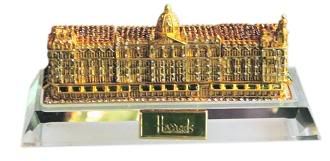
A popular model is a gold, glitzy, perfume coffret-sized model of Harrods (above), which Chang, Goh and Ngiam all own. It cost roughly S$1,200 and can only be expected to be worth a lot more a decade from now.

Chang began collecting solid perfumes in 1987 when she first saw them in Saks Fifth Avenue department store in New York. Her first purchase was a green enamel turtle from Estee Lauder that cost US$60 then but is worth US$200 on eBay today.

She has spent 'easily a five-figure sum' that is 'nearer to $90,000 than to $10,000' acquiring them. One day, she hopes to reap a 'six-figure sum' from selling them. 'Otherwise, what's the point of this painstaking effort?' she asks.

Photo Sharing and Video Hosting at Photobucket

Part of that effort entails keeping the scents in 'mint condition' - meaning there is no change in the colour of the scent, and the seal and original packaging are both intact - so they will fetch a higher price.

She keeps her collection in an air-conditioned room, covered and away from the sunlight. She estimates that her monthly air-conditioning bill is probably 10 to 20 per cent higher than usual because of this. Her 'best pieces' are stored in an air-conditioned warehouse for safekeeping.

Chang, who has a seven-year-old daughter, says her dream is to set up a perfume collectors' convention here so collectors around Asia can meet to trade tips and socialise. She believes that more Singaporeans may start collecting too.

'Some Lalique bottles go for £10,000 (S$30,760) to &pound20,000 at perfume auctions. But since they're so expensive, many will go for the next best thing, which is solid perfume.'


Abdominal muscles exercises

05 Jul 2007, ST, Urban

According to Mr Singapore 2006, it's how you work out, not how much, that makes the difference

Mr Singapore 2006 Dennis Lau is a walking advertisement for his personal approach to exercise. Lau, 24, who is in his final year of material science and engineering studies at Nanyang Technological University, doesn't work his body to the bone to get his lean, sculpted physique.

Instead, he 'targets' the muscles he wants to work, making them reap every ounce of benefit from the exercise.

He explains: 'You can do a sit-up and, if you let other parts of the body get involved, you won't get maximum benefit from it.

'On the other hand, if you force the abs (abdominal muscles) to do all the work, you don't need to do too many.'

Proving his point, Lau confesses that he works out just three times a week: each session involves an 8-to-10km outdoor run, followed by some exercises like push-ups, chin-ups and crunches.

Normally, you'd expect a guy with his physique to be training at least five times a week. A thrice-a-week workout regimen is usually good for people who just want to avoid going up a size or two in their dress size.

But it must work for Lau because there is not an ounce of fat on his 1.76m, 68kg frame.

Of course, there is more to his ripped physique than just exercise - that oft-overlooked factor, diet.

'In order for anyone to have a ripped look, especially the abs, the body fat content has to be low, like 15 per cent. Otherwise, no matter how much you work out, all the muscles will be built under a layer of fat,' he says.

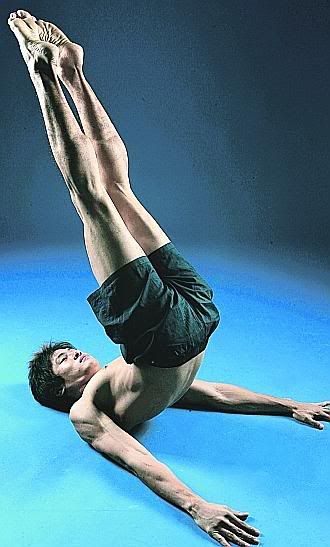
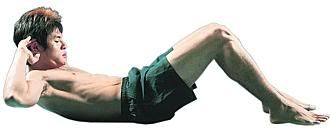
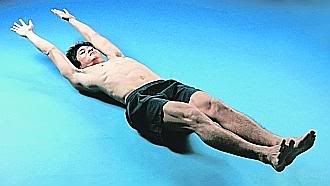
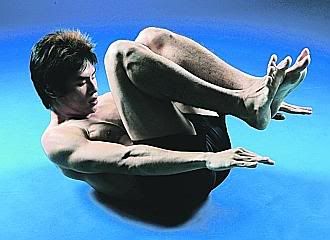
As for the exercises he recommends here - the sit-up and the static crunch can be done by anyone, while the reverse crunch will be tough for beginners - he suggests you start with 10 repetitions of each, without any rest between them, to complete a set. Aim to do three sets.

Lau has one more tip: Rotate the order of the three exercises from time to time. This forces the muscles to develop because they don't get used to a fixed sequence.

---------------------------------

For lower abs

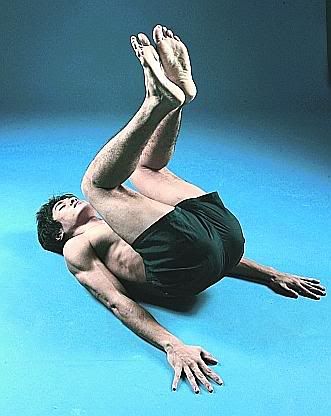
Lie on your back, palms on the floor. Lift your legs and buttocks off the floor as you exhale, then shoot your legs up towards the ceiling and crunch your abs. Hold, then return to start.

Photo Sharing and Video Hosting at Photobucket

Photo Sharing and Video Hosting at Photobucket

For upper abs

Lie on your back with knees bent and hands behind your ears. Lift your upper body about 30 to 40 degrees and crunch your abs hard. The rest of you should be relaxed. Do 15 to 20 times.

Photo Sharing and Video Hosting at Photobucket


For upper and lower abs

Lie on your back, hands stretched over your head. Lift your upper body and legs simultaneously and hold for as long as you can, letting your abs do all the work.

Photo Sharing and Video Hosting at Photobucket

Photo Sharing and Video Hosting at Photobucket


Male nail buffs

05 Jul 2007, ST, Urban

More men are being waited on hand and foot - at the nail salon

The guys are taking a (finger) tip from the gals these days - and splashing out cash on buffing up their digits.

Increasingly, more males are putting the 'man' into manicure, making regular visits to nail salons for neater, cleaner and better-looking hands and feet.

That's according to a check of eight salons by Urban.

For example, international chain O.P.I, which has two outlets in Singapore, has between 15 and 20 male customers a month, a jump from the five to 10 men a year ago.

Over at local nail salon Flair Nails & Beauty Services, owner Victoria Koh says about 15 men a month trot in for a mani or pedi, almost double that of a year ago.

At Daisy's Nail Cottage, the increase is even more pronounced with 20 men turning up on average a month, up from just three to five for the same period a year ago.

They pay anything from $20 to $80 for a manicure, and $25 to $85 for a pedi - slightly more than what women fork out. Men are generally charged more because their feet are bigger and their calluses worse, say those in the industry.

The salons say there are two reasons for testosterone types wanting tidier tootsies and fabulous fingernails.

Some want to spruce up their image and enjoy a little pampering at the same time, while others have physical problems such as infections that need attention.

Staff at O.P.I say they often handle male customers suffering from cracked and split nails.

And at local nail salon Fave Nails, which has three outlets, many men turn up seeking help for ingrown toenails caused by wearing closed-toe shoes for prolonged periods.

Other common problems salons see include thick calluses, hardened, thick skin on hands and feet and fungal infections.

Flair's Koh recalls: 'I once had a customer who had fungus on all 10 of his toenails. I recommended a fungal lotion and had to throw away my tools after treating him.'

One man hooked on talon time is Steven Ong, a private banker in his late 30s. He started getting manis and pedis 10 years ago and now visits a nail salon once or twice a month.

'It's a luxury and I always feel refreshed after a manicure and pedicure,' says Ong, who suffers from ingrown nails.

He has recommended manicures and pedicures to both his male and female friends and adds: 'Some women are surprised. I suppose it's something different for a guy to do.'

Dr Wong Su-Ni, a consultant dermatologist with Pacific Specialist Practice, gives the trend the thumbs-up, noting: 'Some fungal infections have been picked up by pedicurists who refer them to dermatologists.'

Doctors point out that fungal infections are best dealt with in clinics. According to Dr Chris Foo, a consultant dermatologist with Raffles Hospital, they need to be treated by a dermatologist, using anti-fungal medication. In some instances, the nail may need to be removed.

Also, salons' tools must be clean. 'Unsterilised tools allow the spread of viral infections such as warts,' says Dr Foo.

Guys can do plenty of hand-and-foot upkeep at home too.

Moisturising regularly will prevent dry, cracked heels. And if you're in the sun a lot, slap on sunblock to prevent hands developing wrinkled skin.

For those with weak, peeling nails, Tan Juat Li, director of Fave Nails, recommends painting on a strengthener. Macho men worried about a glossy look can use matte shades.

Also, open sandals will help ease the stress placed on toes that often causes ingrown toenails.

--------------------------------

NAIL TIPS AND OTHER HANDY ADVICE

Problem: Dry nails
Signs: Nails are brittle and thin.
Solution: Moisturise your hands and feet regularly. Rub lotion into your nails when moisturising your hands.

Problem: Fragile/brittle nails
Signs: Uneven surface with discoloured areas.
Solution: Can be caused by a variety of conditions including fungal infections, frequent contact with harsh household chemicals, skin conditions such as psoriasis and deficiency of iron or vitamins A, B6 or C. Consult a dermatologist; make sure you get enough iron and vitamins in your diet.

Problem: Leukonychia
Signs: White spots on nails.
Solution: Minor injuries such as damaged cuticles can cause these. Spots will grow out as nail grows. Some white spots, however, are signs of a fungal nail infection.

Problem: Fungus-infected nails
Signs: White, yellow or brown discoloration. Nails become increasingly thick and brittle and free end of nail lifts off nail bed, making white band wider and irregular.
Solution: Consult a dermatologist who may either provide an anti-fungal cream or tablets or remove the infected nail.

Problem: Calluses
Signs: Thick, hardened layers of skin.
Solution: Moisturise regularly and wear socks to bed if you sleep in an air-conditioned room to prevent your feet from drying out further. Use a callus file in the shower.

Problem: Corns
Signs: Smaller than calluses and have a hard centre surrounded by inflamed skin.
Solution: Same treatment as calluses.

Problem: Plantar warts
Signs: A round or oval-shaped wart on the sole with a dark spot at its centre.
Solution: Caused by viruses, they are contagious and can be spread by walking barefoot in changing rooms. Consult a dermatologist who will either freeze the wart with liquid nitrogen or prescribe a solution to peel off the skin a little at a time.


NAIL STATIONS

A LITTLE PAMPERING
Manicures:
30 to 35 minutes. From $30 for basic - removal of cuticles, shaping, filing, buffing and shining, plus moisturising - to $60 for a customised manicure where nails are individually analysed and treated.

Pedicures: 40 to 60 minutes. From $45 for basic, to $80 for a customised pedicure.
02-10 Balmoral Plaza, 271 Bukit Timah Road, Tel: 6735-4500

DAISY'S NAIL COTTAGE
Manicures: 20 to 30 minutes. From $30 to $80.
Pedicures: 30 to 45 minutes. From $40 to $85. There's also a spa range that costs $200 for a manicure and pedicure.
69A Killiney Road, Tel: 6738-0627

FAVE NAILS
Manicures: 15 to 60 minutes. From $20 for an express manicure - shaping and filing and a short massage - to $60 for a spa manicure.
Pedicures: 20 to 90 minutes. From $30 to $75.
05-10 Shaw Centre, 1 Scotts Road, Tel: 6235-5015; 04-16 OUB Centre, 1 Raffles Place, Tel: 6536-6825; B1-08 CityLink Mall, 1 Raffles Link, Tel: 6341-9159

FLAIR NAILS & BEAUTY SERVICES
Manicures: 30 minutes to 11/4 hours. From $30 for basic to $55 for a spa manicure.
Pedicures: 35 minutes to 11/4 hours. From $40, to $85 for a spa pedicure.
Henry Park Apartments, 18 Holland Grove Road, Tel: 6468-3989

ISKIN
Manicures: 35 minutes; $32 including a scrub and hand massage.
Pedicures: 40 minutes; $42 including a light foot massage and foot scrub.
235A South Bridge Road, Tel: 6220-1255

NING SPA
Manicures: 30 to 50 minutes. From $35 for a basic manicure to $50 for a spa manicure.
Pedicures: 45 to 65 minutes. From $45 to $75.
09-00 MacDonald House, 40A Orchard Road, Tel: 6737-0303

O.P.I
Manicures: 30 to 60 minutes. From $25 for basic to $55 for a spa manicure.
Pedicures: 45 minutes to 11/4 hours. From $35 to $85.
02-26 Forum The Shopping Mall, Tel: 6736-1735; 01-07 The Ogilvy Centre, 35 Robinson Road, Tel: 6221-2213

STRIP
Manicures: 20 to 45 minutes. From $20 for an express manicure to $40 for a paraffin manicure.
Pedicures: 20 to 75 minutes. From $25 to $50.
20-01 Shaw Centre, 1 Scotts Road, Tel: 6737-0201, 05-09 Paragon, 290 Orchard Road, Tel: 6836-4874; 02-10 The Cathay, 2 Handy Road, Tel: 6732-9287


Melt away fat

05 Jul 2007, ST, Urban

A new treatment, lipo-dissolve, is less invasive than liposuction. But is it safe?

Beauty sometimes demands toughness, but Suzanne Thomas had never imagined she would agree to have 72 injections of a fat-burning chemical cocktail in her neck and chin.

Yet that is the treatment called lipo-dissolve that the 35-year-old American preschool teacher underwent - twice - several months ago to eradicate the jowls and double chin she hated. She said the discomfort was worth it because 'I absolutely love my results'.

'I just really didn't want to do anything invasive like liposuction,' said the mother of three children younger than six. She would have had little time to recuperate from cosmetic surgery.

Her procedures, which cost a total of US$1,000 (S$1,522), were performed at MedSculpt, a six-month-old centre in Rockville, Maryland, that specialises exclusively in the controversial fat-loss technique.

Marketed as a safer and less invasive alternative to liposuction, proponents say lipo-dissolve is useful for treating small 'problem areas' such as love handles, bra fat and a softening jaw line.

A growing number of doctors, nurses and even spa personnel are offering the procedure known in medical circles as injection lipolysis - and more colloquially as the 'flab jab'.

But critics, among them officials of the American Society of Plastic Surgeons and the American Society for Aesthetic Plastic Surgery (ASAPS), say there is no convincing evidence that lipo-dissolve is effective - or safe.

The procedure is similar to mesotherapy, an older treatment that involves injections of various drugs, vitamins or herbs to banish the dimpled flab known as cellulite.

Lipo-dissolve injections typically contain two ingredients believed to work synergistically. As with mesotherapy, the formula, which is not approved by the Food and Drug Administration, is prepared by compounding pharmacies, which are subject to little regulation.

Lipo-dissolve 'is catching on because it works', said Robert Adrian, one of the Washington area's best-known and busiest cosmetic dermatologists, who says he has treated 400 patients in the past three years.

Adrian, whose website says the procedure 'literally melts away fat in just a few short treatment sessions', maintains that most of his patients have achieved good long-term results.

Officials of ASAPS vehemently disagree. The group cited 'numerous reports of complications including bacterial infection, granulomas (disfiguring masses of chronically inflammed tissue) and localised necrosis (tissue death)'.

What some proponents tout as impressive results, said Alastair Carruthers, president of the dermatologic surgery society, appear to be temporary.

And patients who shell out thousands of dollars for fat-loss injections, critics note, are more likely to watch what they eat and to exercise, which may explain why lipo-dissolve patients say they are satisfied with their results.

Safety remains a paramount concern, according to Carruthers. He said he recently treated a woman in her 40s who nearly lost both lower eyelids after she developed a complication following lipo-dissolve injections administered by a physician. The shots killed tissue under her eyes.

Lipo-dissolve typically contains a mixture of phosphatidylcholine, or PCDC, which is derived from soybeans, and sodium deoxycholate, a bile salt that aids waste removal.

This cocktail is prepared in compounding pharmacies, which typically make small quantities of drugs for specialised treatments. Quality control and sterility can be spotty or nonexistent, experts say.

Using a fine needle, the PCDC solution is injected into fat deposits, typically in the abdomen, face, hips or back.

PCDC shots cause redness, temporary burning or pain and considerable swelling. The injections are believed to trigger an inflammatory response that results in the breakdown and excretion of fat; proponents say the mechanism by which this occurs is unknown.

Two to six treatments are usually required, each of which costs US$300 to US$1,500.

Lipo-dissolve proponents, including MedSculpt officials and Adrian, say that no deaths have been reported anywhere from the procedure and that their shots are carefully prepared in reputable pharmacies.

But in cosmetic dermatologist Elizabeth Tanzi's view, basic questions about the treatment remain unanswered.

'If I thought it worked and was safe, I'd have it,' she said.

--------------------------------

Lipo -dissolve

What: Lipo-dissolve is a new treatment which dissolves fat in small problem areas such as love handles and sagging jawlines.

How: Like mesotherapy, lipo-dissolve works on fat through injections of two ingredients that are thought to work together to burn fat.

Cost: Two to six treatments are usually required; each treatment costs US$300 (S$457) to US$1,500.

Side effects: Swelling and pain are typical. Also, the chemical cocktail has not been approved by the FDA.


Giving age the boots

05 Jul 2007, ST, Urban

Sales of Boots' No. 7 Protect & Perfect anti-ageing serum soar after a BBC programme
London - Britain's new cult favourite skincare line is Boots' No. 7.

When the homely brand first introduced its Protect & Perfect anti-ageing serum (right) two years ago in Britain, consumers hardly took notice.

That changed when the BBC broadcast a special report on beauty products in March. A dermatologist's analysis showed that the serum actually might work, the BBC reported.

Sales promptly exploded.

'After the programme, there was an initial sales uplift of 2,000 per cent,' Boots spokesman Lucy Folks said.

In a single weekend, the chain sold 160,000 bottles. The manufacturing plant has increased production from 20,000 bottles a week to 20,000 bottles a day.

At 8.30am on a recent Wednesday, the scene at Boots Sloane Square, a tourist-filled neighbourhood in central London, was all squealing women and nervous staff.

'This is about the eighth time I've come, and now I finally got it,' chirped one customer.

Because the serum is in such high demand, Boots is restricting shoppers to one bottle each.

Interest in the anti-ageing serum mushroomed after the BBC featured medical professor Lesley Regan testing various over-the-counter brands in search of the best beauty products. During the televised hunt, she took the Boots serum to Manchester University, where professor Chris Griffiths, head of the dermatology department, carried out experiments and found that Protect & Perfect was the most effective.

'At both basic science and clinical levels, Boots' No. 7 Protect & Perfect has been shown scientifically to repair photo-aged skin and improve fine wrinkles associated with photo-ageing,' he announced to the network.

Not all dermatologists are convinced, however, that this serum, or any other, repairs ageing skin.

'Most of the anti-ageing creams have vastly too little retinol to make a difference,' said Dr John J. Voorhees of the University of Michigan Medical School.

He and his colleagues recently published a study on the effects of retinol on ageing skin. They found that high levels of the vitamin A- derived substance trigger collagen production just under the skin, reducing fine lines and protecting the surface from injury and even ulcer formation.

The key to retinol's success, however, is a high enough concentration to allow it to be absorbed into the skin to promote a healthier appearance. If the retinol concentration is low, the product is unlikely to make a significant difference.

'If Boots and other creams have enough retinol in them, and if that retinol exits the cream into your skin, you might actually have an effect,' Voorhees said.

But he added: 'Consumers should not expect much to happen when they use retinol products. All creams are moisturisers, and moisturisers fill in the nooks and crannies and make the skin look better. So people will think their skin is better, but nothing is really happening.'


The skinny on looking good

05 Jul 2007, ST, Urban

Urban lets you in on zero- effort tricks to look thinner, trimmer and firmer in a snap - treadmill not required

You've procrastinated starting that new fitness routine. You've even cheated on your diet. Well girlfriend, we're not going to berate you or beat you into submission. That's your gym instructor's job.

But we're going to help you cheat at looking skinny and feeling firmer and tighter, without breaking a sweat. Really. It's all about good posture and positioning, clever handiwork and the right beauty aids to buff and polish bodies back into shape.

Call it our 4-step Lazy Girl's no-sweat, pain-free guide to get skinny, pronto. Because the only time you should kick off your Christian Louboutins and run a race is when there's a Prada sale at the end of the line. Enjoy.

1. Better posture makes you look thinner

When you slouch, it makes your gut hang out. Just straightening up and standing tall makes you look leaner and taller instantly. There are long term benefits too, as Wendy Lim, senior physiotherapist from the Sports Medicine Centre at Alexandra Hospital, explains: 'It activates the core muscles - deep in the abdomen, the upper back and the pelvic floor. When you work your muscles in the correct manner, you end up burning fat efficiently.'

How you sit also makes a difference. And since most of us spend most of our time at the desks, this is one thing you need to correct right now.

The right position is to sit with both feet on the floor, with just a natural slight curve at the small of the back, squeezing the glutes and slightly tightening your tummy muscles. 'This not only creates a leaner look, but, again, helps you exercise your muscles properly, and burn fat,' says Ms Lim.

Tip: Stick a Post-It note on the top right of your computer to remind yourself to sit up straight always.

2. Lounging your way to lean

Basking by the pool is the fastest way to strip a woman of her confidence. Take heart: A black one-piece tank, cut high on the thigh, is a universal slimming style.

But there are other ways to cheat at looking slimmer, even while lying down. Take cues from the pros.

Freelance fashion stylist Martin Wong advises: 'When lounging, lie back and stretch your legs as much as they will go. This elongates them. Also bend the knees slightly, so your thighs don't spread.'

He adds that to instantly shrink the tum, stretch and raise your arms high over your head when reclined.

Another trick to hide a belly when sitting down on your deck chair, freelance fashion stylist Steven Kong advises, 'is to prop your knees in front of you and drape your arm over them.'

Save your yoga sit in poses for class - 'it's a terrible angle because all the compression only shows off your cellulite.'

3. Massage to debloat

It's our favourite way to cheat. Even better since you can catch some shut-eye at the same time. Every spa or beauty salon will offer its own body tightening, lifting, contouring solutions, but the Pro Body Redefining Treatment ($128 for 60 minutes) at the Clarins Institute (05-05/06/07 Wheelock Place, tel: 6838-5060) never fails to help us shed excess water baggage and tighten us up quickly to fit into an event outfit. Some of the beauty editors in town also swear by it to shift post-maternity bulge.

It's a combination of massage work and exercise - merely a couple of leg lifts and contractions, nothing overly strenuous - that you do still lying on your back.

According to Clarins' beauty therapist Sylvia Lim, the massage and contractions help to break down the stubborn fat deposits that lie between your skin and muscles.

Other massage movements also boost lymphatic drainage to rid trapped lymph fluids and toxins in the body - a result of high salt intake, medication or poor circulation, especially if you're sedentary - that can cause tummy bloat and heavy thighs.

What's used in the treatment is a combination of products that include the brand's signature products like Anti-Eau oil to get rid of water retention and improve circulation, Total Body Lift cream to reduce sponginess, firm and tone skin and Body Shaping Cream to break down stubborn fats.

4. Get tanned to get skinny

It's an art class basic. Light emphasises, shadows recede.

'It's like wearing a darker outfit,' says celeb make-up guru Andy Lee. 'A tan can make you look slimmer.'

But before you run out and bare your butt, think fake bake. And with today's easy-to-use and more natural looking bronzers and self-tanners, there's no need to lie out in the sun and expose yourself to unnecessary skin damage.

Even better, with skilful shading, you can 'shave' pounds off a puffy face, give yourself cheekbones and even ab definition. Make-up artist Lynette Leong shares tips:

To slim down a broad face: Use a bronzing powder - it's less streaky than a cream product and much easier for a novice to pull off - on your jawline along the chin, blending it into the neckline. Go two shades darker than your normal skin tone.

To create cheekbones: Suck in cheeks and apply bronzing powder where the cheek hollows are, using an upward stroke towards the hairline hollow. Finish off with a light dusting of bronzing powder around the temple, blending it seamlessly.

For greater ab definition: Use a cream or mousse product instead of a powder.

'It's more efficient since you're working with a bigger surface area and it gives a more natural finish too.

'Feel where the muscles pop out, then use your little finger to apply tanner or bronzing cream over the contour of the muscle. This will define it. Work fast so you don't end up with streaks,' says Leong.


Sniffing out a good bargain

05 Jul 2007, ST

I may not sport the latest high-fashion threads, but my one indulgence is scent

By Ong Sor Fern, culturevulture

I RECENTLY appalled a friend of mine when I told her how much I had spent at a boutique for perfumes.

Her exact words: 'I actually blinked.'

This from a girl who does not bat an eyelid at designer outfits tagged at over $1,000 and shoes that cost the equivalent, or more, of an iPod.

I thought $400 was not that big a bill for a 100ml bottle of liquid pleasure and a clutch of wonderfully scented candles, which, by the way, were discounted at 40 per cent.

But I guess it is all a matter of priorities.

I am more likely to sport a bargain vintage frock than the latest high-fashion threads. I balk at spending more than $80 on a pair of shoes.

But my one indulgence is scent.

My curiosity was first sparked by a rather cheesy novel I had read in secondary school, Johanna Kingsley's Scents.

While I only vaguely remember the book as a pulpy read, what entranced me was its setting, in the perfumery business. The story taught me about the Nose, not the anatomical feature but the nickname the perfume industry gives to its most important occupation.

It refers to a man whose olfactory abilities are so acute he can instantly identify a scent. Not only that, he is able to arrange scents in such combinations as to create liquid gold in a bottle.

The book led me to my first perfume revelation. I had decided to buy a perfume as a sort of extension of the literary experience, and settled on, in a now forgotten piece of teen girl logic, Chanel No. 5.

This is possibly the most famous scent in the world, the first perfume to employ synthetics called aldehydes in its composition. It was created for French fashion designer Coco Chanel as a signature fragrance for her boutique.

But my encounter with the perfume was a disaster. I detested the cloying rush of ylang ylang and jasmine immediately. It was like being pummelled by flowers. That was my first lesson in chemistry.

For that is what perfumes are all about, literally and metaphorically. They are complex chains, constructed meticulously down to the last specific molecule.

Despite their scientific birth in petri dishes, perfumes come swathed in pretty flacons and draped in wreaths of flowery language that aim to create a mythic experience for the buyer.

Because ultimately, the chemistry that bonds a scent to its devotee is inexplicable. Whatever the science that goes into the creation of a scent, its success or failure finally depends on a mysterious alchemy that happens when the molecules meet a buyer's nose.

That reaction is instantaneous and instinctive, as I found out. Instead of No. 5, I ended up falling for the lesser known No. 19. This iris-based scent was a cool, clean bath of clarity after the overwrought frilliness of No. 5 and it was the beginning of a lifelong affair with the pleasures of perfumes.

Nina Ricci's L'air Du Temps and Estee Lauder's Pleasures were girlish guilty pleasures with their soft florals. Calvin Klein's Obsession For Men was a more appealingly full-bodied scent compared to the overly sweet version for women.

Then I discovered boutique perfumers like Annick Goutal, Serge Lutens and L'Artisan. Their perfumes were towering symphonies compared to the pleasing pop ditties that were the commercial scents from fashion labels.

My passion has also been fed partly by books as I sought to identify its various aspects.

One of these was Patrick Suskind's darkly funny Perfume (1976), where the Nose also happened to be a psychopathic murderer whose ambition was to build the perfect perfume by distilling the essences of 12 virgins.

The book was a swoonsome love affair with smells both good and bad. The author's considerable literary ability and writing style was wholly bent to the purpose of describing smells in all their infinite variety and effects.

Then there was Chandler Burr's entertaining The Emperor Of Scent (2003). This non-fiction account of scientist Luca Turin and his controversial theory of smell was another great behind-the-scenes look at not just the secretive world of perfumeries, but also the byzantine corridors of scientific research and publication.

Part of my fascination with perfumes comes from the fact that it is the product of this seemingly contrary intersection between the orderly logic of the scientific world and the frivolous excess of the fashion world.

Perfume devotees consider a well-made perfume a work of art. But cynics might see little sense in shelling out $188 on what is essentially air.

But the perfume industry has built a US$20 billion-a-year business by luring a consumer to spend money on an ephemeral experience that literally evaporates upon consumption.

One could argue that, in essence, is the nature of art.

What is theatre but a fleeting encounter in a proscribed space and time? What is music but a collection of sound waves within a defined temporal span?

Similarly, a perfume offers a pleasurable sensory escape which takes one out of the boundaries of daily routine.

Like art, it is a luxury good which can only be consumed once society has already addressed the pesky issue of survival.

So go ahead and take a deep breath at perfume counters. That is the smell of the good life.


Wednesday, July 4, 2007

Empty Nest, the birds have flown!

What a difference a day makes! Today the nest is empty. There is no sight of the other 2 baby birds. I wondered if they had survived and are nesting somewhere? Or they had been killed somewhere in their first few days of flight?

bird17_0407

bird14_0407

Across the other pipe, I spotted 3 birds. The one on the right is the papa bird and the two birds cuddled together should be the mother bird and one of her baby bird.
bird18_0407

Keep youth at hand

28 Jun 2007, ST, Urban

Liver spots and crepey skin on your hands can give away your age. The experts tell Urban what you can do to hide your years

We use 'em, abuse 'em and neglect 'em. It's no wonder our hands show signs of ageing faster than our faces. Not only are they most exposed to ultraviolet rays - honestly, how many people use sunscreen on their hands - they take a beating from all kinds of aggressors.

As plastic and hand surgeon Ivor Lim says: 'Our hands are one of our primary sensors, and because we tend not to keep them covered, it leaves them exposed to sun damage, skin wrinkling or even trauma like burns (like cooking oil splatter) and cuts that can result in scars or post-inflammatory hyperpigmentation. All these factors can make them look pigmented, marked and therefore old.'

One major culprit lies in the home. Says Lynne Lim, Kose's assistant general manager of marketing: 'Most people don't wear gloves when they do household chores. That exposes their hands to household and industrial chemicals like detergent and plant fertilisers.'

Couple that with dryness caused by air-conditioning and chronological ageing, and little wonder our hands can look the worse for wear.

For already maturing women, the liver spots and crepey skin give away their true age, no matter how many peels, Botox jabs or facelifts they get.

Thankfully there are more preventative and reparative aids like light therapy (heat energy is used to remove marks or tighten skin) and anti-ageing hand creams to stop the tell-tale signs.

Even better news: Asian skin is thicker than Caucasian skin and that means Asians have a couple of years more before we lose skin elasticity that causes wrinkling, says Dr Lim.

'The intrinsic pigmentation in Asian skins also helps to protect against sun damage and is less prone to scarring than Negroid skin,' he adds.

What happens to hands as we age?

In your 20s

Dryness, hardened cuticles and brittle nails are the most common problems, says Brenda Loke, marketing and PR manager of French beauty house, Clarins. The great culprits: Wearing and removing nail polish constantly and the dehydration caused by air-conditioning.

In your 30s

The ageing of hands (as perceived by their appearance) becomes more obvious from the late 30s, says Dr Lim. Sun exposure strips natural skin emollients and can cause liver or age spots. You start to see skin wrinkling due to loss of elasticity.

In your 40s

The fat under your skin thins out. The tendons, bones and veins stand out more making hands look gnarled, says Dr Lim.

In your 50s and above

Skin sags and is dull-looking. Pigmentation worsens and nails become brittle. The skin loses the ability to retain moisture and hands feel dry and rough, says Jennifer Chia, sales and marketing manager of PharMed, the local distributor of Palmers hand-care products. If symptoms persist, they become irreversible after 60.


How to make hands look younger

Some problems are easier to treat than others and don't need more than a good hand cream to fix. For example, dehydration and fine lines that result from that.

Paraffin waxing, says Chia, can soften skin and reduce the appearance of fine lines, too.

Pigment changes like liver spots can also be prevented by using sunscreen and keeping one's hands covered. To remove age spots, procedures such as radiofrequency light therapy and laser therapy are done, says Dr Lim.

Constant hydration and wearing sunblock can also help prevent the loss of skin elasticity. But if you already have crepey skin, then consider radiofrequency treatments like Thermage or Refirme that use heat energy to tighten and firm the skin.

To restore subcutaneous fat - a normal consequence of ageing and not preventable - a fat transplant can be done, using your own tummy or thigh fat.

'OUR HANDS DRY UP EVERY TIME THEY COME INTO CONTACT WITH WATER. GET INTO THE HABIT OF APPLYING HAND CREAM THROUGHOUT THE DAY, EVEN AT THE OFFICE'
- Lynne Lim, Kose’s assistant general manager of marketing

Easy DIY treat

- Exfoliate hands with a mild body scrub. Do pick one with microbeads, not coarse pit granules, as they are less drying. Work the scrub in thoroughly from fingers to elbows.

- Rinse off and apply a face mask to hands. Go for a cream-based hydrating formula, since this will put moisture back into skin. Leave on for 10 minutes.

- Rinse off with warm water, and apply a hands and nail cream from fingers to wrist, right up to the elbows. Don't neglect the cuticles.

Slather Up

Here are hand treatments that do good and are absorbed fast so you can still open doors and not leave grease marks all over your things.

Clarins Age-Control Hand Lotion SPF15, $37, from Level 1 Tangs Orchard:

The milky lotion is so lightweight it feels like you haven't got anything on. But it brightens and softens your skin instantly.

Sally Hansen Age Correct Retinol Hand Creme, $15.10, from Watsons:

Reportedly helps to diminish the appearance of fine lines and fade discolouration.

Palmer's Cocoa Butter Formula with Vitamin E Therapeutic Hand Cream SPF8, $17.80, from Guardian Pharmacy:

Hydration and sunscreen in one, it can also be used on the lips.

Cosme Decorte Hand Renew Treatment, $60, from Level 1 Takashimaya:

This anti-ageing moisturiser for hands evens out dull, patchy skin, and firms and smoothens, too.

Inselene Golden Olive Natural Therapy Water Drop Essence Hand Cream, $12, from Robinsons Raffles City and The Centrepoint:

The balm transforms to water as you massage it in and can be used to soften scruffy heels and elbows, too.

Talika Hand Ritual Kit, $117, from Spa Lon, 02-04/05 Chijmes:

The two-part kit comes with a scrub (left) that uses salt and sugar crystals to take off dull skin and prep it for the repair action of the serum. The latter also helps to brighten the skin and reportedly reduces and prevents the formation of wrinkles and dark spots.